The Saffron Finch
| Saffron Finch8,10,11,34,35,37,41 | ||||||||||||||||
| Sicalis flaveola, several subspecies | ||||||||||||||||
 | ||||||||||||||||
| Tanager (formerly bunting) | ||||||||||||||||
| ||||||||||||||||
Other common names
Brazilian Saffron Finch, Brazilian Bunting, Brazilian Canary, Northern Saffron Finch, Jamaican Wild CanaryS. f. pelzelni (Pelzeln's Saffron Finch or Southern Saffron Finch) is slightly smaller than the nominate form, more subdued in color, and has blackish streaking on the flanks. It is sometimes considered its own species, S. pelzelni.
Origin
South AmericaArea of distribution
Most of South America including: Netherlands Antilles, Colombia, Suriname, Argentina, Peru, Brazil, Venezuela, Paraguay, Uruguay, Bolivia, Ecuador, and Guyanas (also introduced to: Hawaii and Jamaica among other places).Disposition
These birds should be evaluated on an individual pair basis. They may be spiteful or intimidating to smaller, more passive species, although some pairs are fairly tolerant (if a large enough, well-planted enclosure is provided). They may become more aggressive during breeding; in some cases, cock birds have been known to kill their mates or juveniles.Physical descriptions
Black maxilla (upper beak), pale mandible (lower beak), greenish yellow back, yellow under parts, wing and tail feathers are black lined with yellow, dark pink legs. The cock often has an orange forehead while the hen often has more dark streaks.The Orange-Fronted Yellow-Finch (Sicalis columbiana) appears very similar to the Saffron Finch, but is smaller (4.7" or 12cm), has almost no streaking (even in the hens and juveniles), and has dusky lores (saffron finch has yellow lores), as seen in this photo of a pair
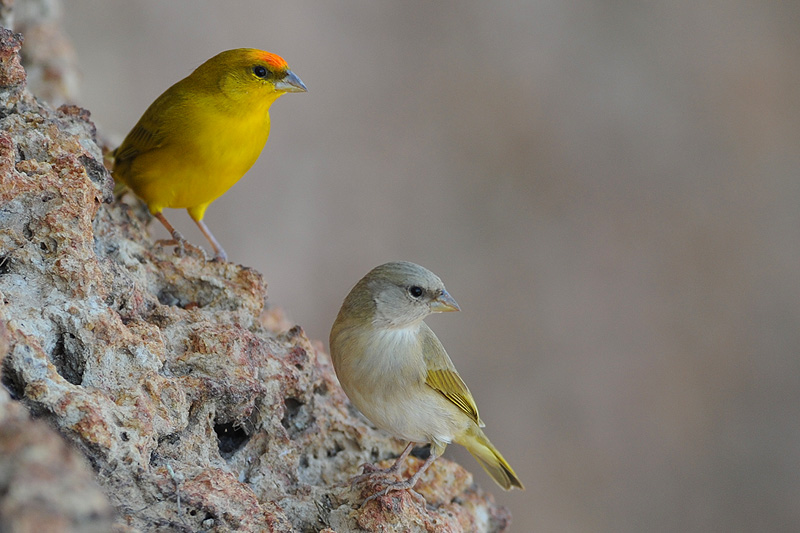 (cock on left, hen on right).
Sexing
The hen is more dull in color and her under parts are paler. She may appear to be similarly colored to a juvenile (being mostly gray with dark streaks). However, as the birds age their color tends to become more intense, so that older hens may appear brighter than cocks in their first adult plumage. Though the cocks are largely similar, the appearance of the hens varies by subspecies.- S. f. pelzelni hens show greater sexual dimorphism; they lack the orange crown and have whitish underparts and streaking on the chest and flanks, similar to the juvenile. Juvenile cocks have yellow under the wing whereas juvenile hens have cream under the wing.
- S. f. brasiliensis hen is more similar to the cock but is overall duller and has no orange on the crown.
Song
These birds sing a series of single and double notes with an occasional brief trill.Pictures
If you keep this species and have a photo of your birds to share, please submit your photo for possible inclusion on this site! Credit will be given to you.
Photo by Dario Sanches

Photo by Dario Sanches

Photo by Dario Sanches

Photo by Julian Londono

Photo by Bart van Dorp

Photo by Anita Gould

Juvenile. Photo by Alejandro Bayer Tamayo

Photo by Alejandro Bayer Tamayo


Favorite foods
Live food (insects), greens, oats.Natural habitat
These birds are found in the open and semi-open lowland areas (grasslands, rivery valleys, and brushy areas) of semi-arid South America. They can also be spotted in parks, gardens, and towns. When breeding, they may build their own nests in tree hollows, crevices in walls or rocks, or may make use of abandoned Horneros' nests (a spherical, soccer-ball sized mud nest).Habits
During the winter these birds live in flocks, and during Spring they pair off for breeding. They do not migrate. These birds spend a lot of time on the ground seeking food.Special considerations
May become lethargic in a cage and prone to obesity. Providing a spacious enclosure and feeding an austerity diet when not breeding is recommended. For this species, ambient temperature should not drop below 46°F (8°C) for prolonged periods.Because they can show very aggressive behavior, avoid housing saffron finches with other birds who have yellow plumage. If transportation is necessary, each bird should have its own enclosure or compartment to prohibit stressed birds from attacking each other. Use dense planting in the enclosure (thick shrubs and seeding grasses) to combat aggression; allow some open areas for the birds to fly through and access the ground.
Old birds tend to have raised scales on the legs. Saffron Finches may become affected by intestinal parasites including coccidia as well as air sac mites; routine anti-parasitic treatment is recommended. Saffron Finches live about 11 years in captivity.
Has reportedly hybridized with the Yellow Canary (Serinus flaviventris), the domestic canary (S. domesticus), the chestnut-capped blackbird (Agelaius ruficapillus), the grassland yellow-finch (Sicalis luteola), and the subspecies Pelzeln's Finch (S. pelzelni).
Breeding season
Spring and Summer (in South America); may vary with wet/dry seasons. Breeds in the spring in captivity (April/May in the Northern Hemisphere).Breeding tips
Birds can breed while still in juvenile plumage & may not attain adult plumage until 2-3 years of age. Birds aged 2 through 5 years are best suited for breeding, however. A breeding diet including live food & insectivore mix, soaked seed, and half-ripe seed should be provided at the end of winter in preparation for spring breeding.This species should be offered a large, well-planted aviary for breeding. They are best bred one pair per enclosure and not in a mixed collection nor as a colony as they are disruptive to the breeding of other birds and can become quite aggressive.
Pairs should be introduced into a cage together during the winter since males become more aggressive during the spring breeding period. If the pair seems compatible, they can then be released into the breeding aviary. If interested in breeding, both birds will begin to collect nesting material and the cock will feed the hen. During courtship, the cock tends to chase the hen while keeping his head and neck feathers erect and wings drooped. He may dance around the hen while singing, bowing and vibrating his wings. If the hen is receptive, she will crouch low with spread wings and vibrate her tail. Copulation then takes place on the ground or on a perch.
Being cavity nesters, they appear to prefer a half-open (6") or enclosed budgerigar nest box. Sometimes a pair will construct a nest within clumps of branches within the aviary. Provide coconut fiber, soft dry grasses, kapok, leaves, roots, and soft feathers as nesting material. The white eggs with dark spots are mostly incubated by the hen; the cock guards the nest and feeds the hen. Avoid nest checks.
Both parents feed the young. Live food (termites, moths, small crickets, medium mealworms) is considered important for successful rearing of chicks. The hen stops brooding around 8 days of age. Once the chicks fledge, the cock will continue to wean the fledglings while the hen starts her next clutch. Pairs tend to rear 2-3 broods per season. If the aggressive cock bird is removed before the young are weaned, the hen is unlikely to continue rearing the young successfully on her own.

Saffron parent feeding fledgling. Photo by Mariani Malinowski.
Saffron Finches form a strong pair bond and should be allowed to stay together year-round, even when not breeding. If it becomes necessary to replace a mate, the unacquainted birds should be introduced slowly and cautiously to monitor for any signs of aggression. The birds should first meet through a wire partition limiting physical access for the first week, then be placed within the same enclosure under very close supervision for a further week before putting the pair in the breeding enclosure.
If fostering becomes necessary, saffron finch chicks may be able to be reared by domestic canaries.
Life Cycle
| Clutch size: | 3-7 eggs |
| Incubation: | Done by the hen |
| Hatch date: | After 12-14 days of incubation; chicks are fed by both parents |
| Fledge date: | At 17-20 days of age |
| Wean date: | About 4 weeks of age, 9-10 days after fledging (remove as soon as they are independent) |
| First molt: | 12-18 months of age |
Related Article(s)
If you own this species and would like to write an article about your experiences with them for this page, please submit your article for possible inclusion on this site. Credit will be given to you!Saffron Finches
- The Saffron Finch
 - Photos and a brief species profile.
 - Saffron Finch (Sicalis flaveola) - Videos, sound clips.
- Saffron Finch - A Singing Wings Aviary species profile.
Additional References
A Field Guide to the Birds of Brazil by Ber van Perlo